

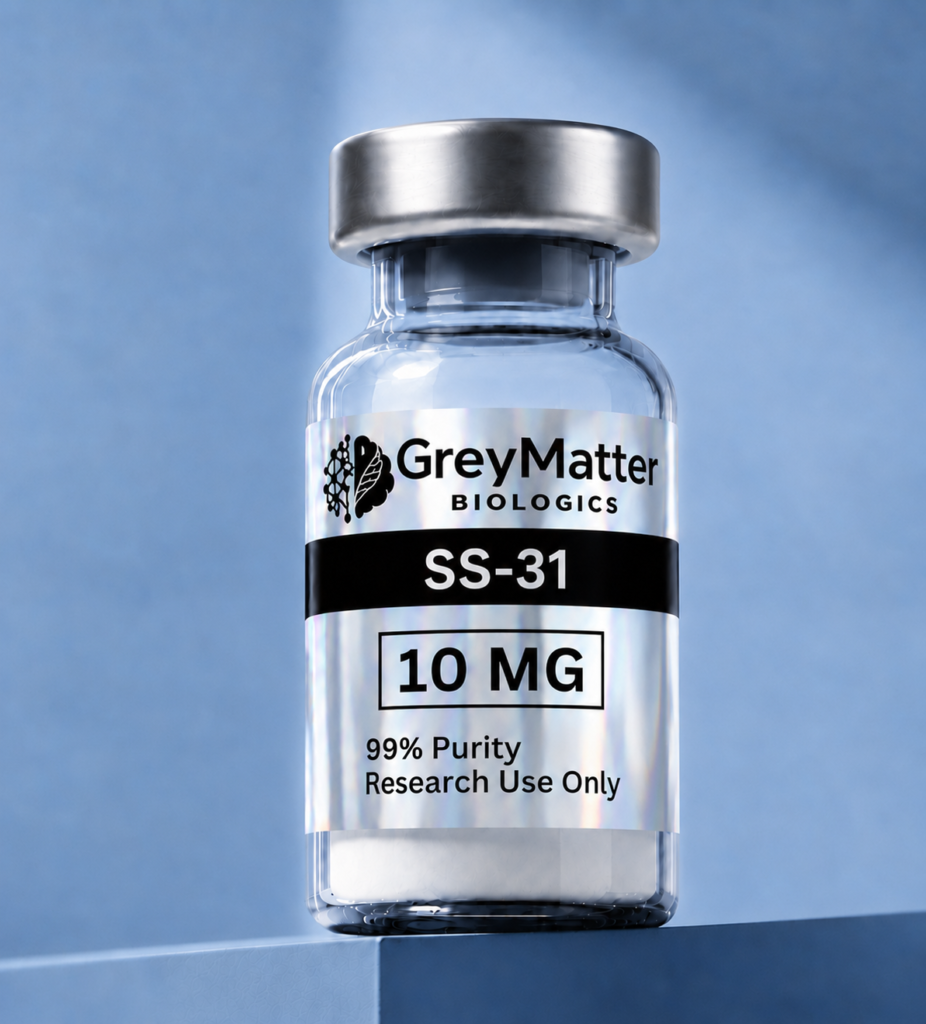
 Third-party tested
SS-31
A mitochondria-targeting tetrapeptide (D-Arg-Dmt-Lys-Phe-NH₂) that selectively associates with cardiolipin-rich inner mitochondrial membranes, improving electron transport chain efficiency and reducing reactive oxygen species production in preclinical models of mitochondrial dysfunction and oxidative stress.
Availability: 3 in stock
SS-31, by the numbers.
Structural and laboratory facts that define this compound. For laboratory research use only.
D-Arg · Dmt · Lys · Phe-NH2 tetrapeptide
Aromatic-cationic design, at physiological pH
g/mol · C32H49N9O5
Reported accumulation vs. cytosol, in vitro
The SS-31 molecule
A schematic atomic representation shown next to the compound's molecular data. The figure is illustrative, not a measured conformation.
How it is studied.
Mitochondria-targeted cardiolipin interaction studied in 100+ preclinical and clinical publications
SS-31 selectively concentrates in the inner mitochondrial membrane (IMM) where it binds to cardiolipin — a unique phospholipid exclusive to mitochondria. This interaction stabilizes cardiolipin's structure, which is critical for cristae morphology and the assembly of electron transport chain (ETC) supercomplexes.
- Binds cardiolipin at the inner mitochondrial membrane
- Stabilizes ETC supercomplex assembly
- Restores cristae morphology in damaged mitochondria
The dimethyltyrosine (Dmt) residue within SS-31's sequence confers potent antioxidant capacity concentrated at the site of ROS generation. In preclinical models of ischemia-reperfusion injury, SS-31 administration was associated with significantly reduced mitochondrial superoxide production and preserved electron transport chain efficiency.
- Dmt residue provides targeted antioxidant capacity
- Reduces mitochondrial superoxide generation
- Preserves electron transport chain efficiency
By preserving cardiolipin integrity and reducing oxidative damage to ETC complexes, SS-31 supports restoration of the proton gradient across the IMM and improved ATP synthase function. Preclinical data in aged rodent models demonstrated improved mitochondrial membrane potential and ATP production rates.
- Restores mitochondrial membrane potential
- Improves ATP synthase coupling efficiency
- Enhances mitochondrial respiration in aged tissue models
Research pathway map
The primary pathways SS-31 is investigated against in laboratory models.
Compound details.
Storage & handling
Supplied as a lyophilized powder. Store the sealed vial refrigerated at 2–8°C, protected from light and moisture; −20°C for long-term storage. Keep reconstituted material refrigerated.
Br J Pharmacol · 2014First-in-class cardiolipin-protective compound as a therapeutic agent to restore mitochondrial bioenergetics
Review of SS-31 interaction with cardiolipin and its effects on mitochondrial bioenergetics in preclinical models.
Szeto HH, 2014 · PubMed ↗J Am Soc Nephrol · 2013The mitochondrial-targeted compound SS-31 re-energizes ischemic mitochondria by interacting with cardiolipin
Examines cardiolipin binding and cytochrome c function in ischemia models.
Birk AV et al., 2013 · PubMed ↗Aging Cell · 2013Mitochondrial-targeted peptide rapidly improves mitochondrial energetics and skeletal muscle performance in aged mice
Preclinical study of mitochondrial energetics in aged rodent models.
Siegel MP et al., 2013 · PubMed ↗J Biol Chem · 2004Cell-permeable peptide antioxidants targeted to inner mitochondrial membrane inhibit mitochondrial swelling, oxidative cell death, and reperfusion injury
Early characterization of the Szeto-Schiller peptide series and their mitochondrial uptake.
Zhao K et al., 2004 · PubMed ↗