

⚠️ RESEARCH PURPOSES ONLY — This compound is not FDA authorized for human consumption. All referenced data is presented for informational and educational purposes only.
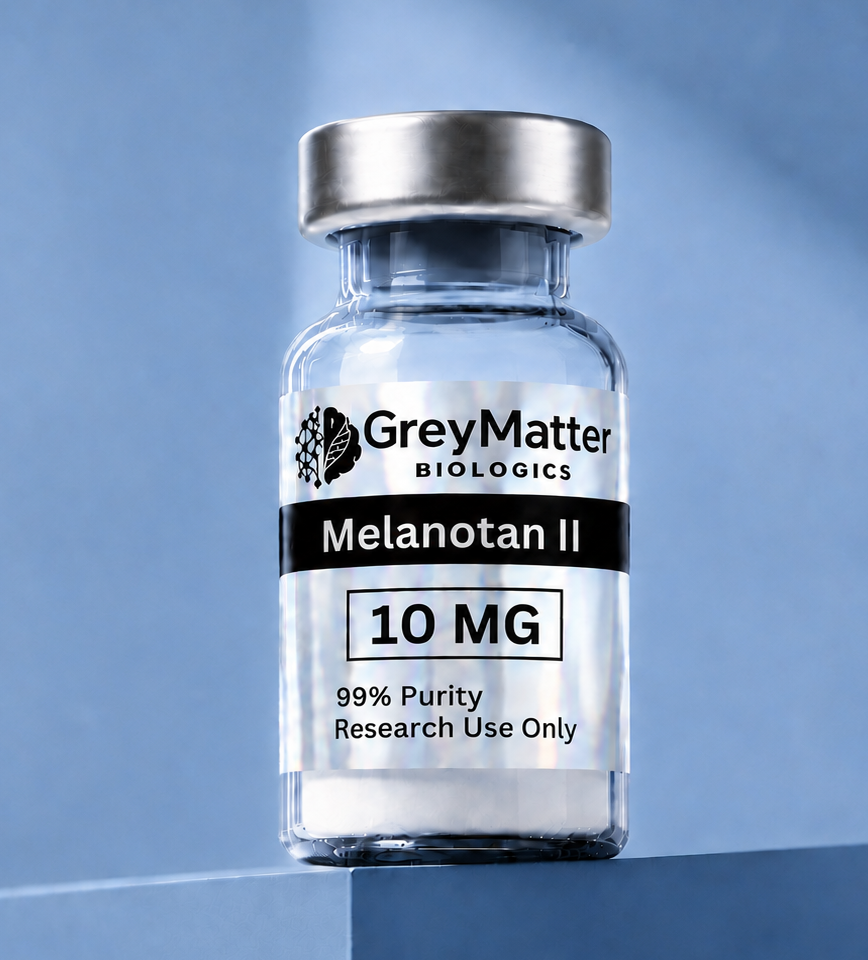
Melanotan II 10MG
$30.00
Availability: 9 in stock
How It Works
Non-selective melanocortin receptor agonism studied across pigmentation, metabolic, and sexual function research
Melanocyte Stimulation & Pigmentation
Melanotan II (MTII) activates MC1R on melanocytes, stimulating intracellular cAMP production that drives melanogenesis — the synthesis of eumelanin (brown-black) pigment. This mechanism has been extensively studied as a model for understanding UV-independent tanning and photoprotective pigmentation pathways.
- Potent MC1R agonism drives eumelanin synthesis
- Activates adenylyl cyclase/cAMP/PKA signaling cascade
- Increases melanin production without UV exposure in models
Central Appetite & Arousal Pathways
MTII's high-affinity binding at MC4R in the hypothalamus modulates both appetite suppression and arousal-related signaling. MC4R knockout studies demonstrate these pathways are distinct. MTII's non-selective binding at MC3R and MC4R makes it a pharmacological tool for dissecting melanocortin circuit functions in energy balance research.
- MC4R activation suppresses food intake in animal models
- Modulates hypothalamic energy expenditure circuits
- Precursor to the more selective PT-141 (bremelanotide)
Non-Selective Pan-MC Agonism
Unlike its derivative PT-141, Melanotan II is a non-selective melanocortin receptor agonist that activates MC1R through MC5R with varying affinities. This broad receptor activity makes it uniquely valuable as a pharmacological probe for studying the full melanocortin system in preclinical research, while also contributing to its broader side-effect profile.
- Binds MC1R, MC3R, MC4R, and MC5R
- ~1000× more potent than endogenous α-MSH at MC receptors
- Cyclic D-Phe substitution confers metabolic resistance
What Research Has Shown
Key preclinical findings from published studies
Research Applications
Primary areas of investigation
Melanogenesis Research
Extensive research into MC1R-driven melanin synthesis, including UV-independent tanning mechanisms and photoprotection models. Used as a pharmacological tool to dissect melanocyte signaling pathways and study disorders of pigmentation.
Dorr et al. 1996 ↗Appetite & Metabolic Research
MTII is a key pharmacological tool in obesity and energy homeostasis research. MC4R activation reduces food intake and increases energy expenditure in rodent models; used extensively to validate the melanocortin hypothesis of body weight regulation.
Fan et al. 1997 ↗Arousal Pathway Models
Preclinical research using MTII as a non-selective MC agonist probe contributed to the discovery of melanocortin-mediated arousal pathways, eventually leading to the development of PT-141 (bremelanotide) as a more selective MC4R-focused compound.
Wessells et al. 1998 ↗Melanocortin System Probing
As a potent non-selective MC receptor agonist, MTII serves as a pharmacological tool for receptor binding studies, structure-activity relationship (SAR) research, and comparison of downstream signaling cascades across the five melanocortin receptor subtypes.
Sawyer et al. 1993 ↗Compound Information
Technical specifications