

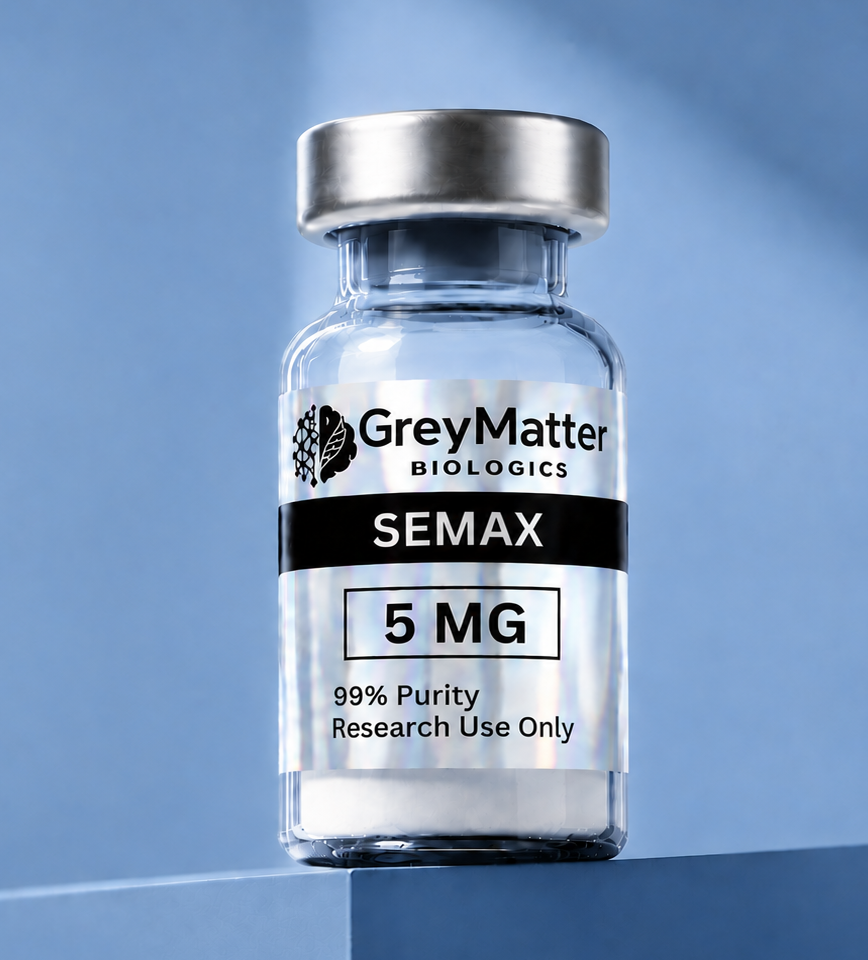
 Third-party tested
Semax
A synthetic heptapeptide analog of ACTH(4-10), studied for neurotrophin (BDNF) expression in laboratory models.
Availability: 9 in stock
Semax, by the numbers.
Structural and laboratory facts that define this compound. For laboratory research use only.
Synthetic heptapeptide
g/mol · C37H51N9O10S
ACTH(4-7) core + Pro-Gly-Pro
Reverse-phase HPLC
The Semax molecule
A schematic atomic representation shown next to the compound's molecular data. The figure is illustrative, not a measured conformation.
How it is studied.
Neuropeptide derived from ACTH with cognitive-enhancing and neuroprotective properties
Semax increases brain-derived neurotrophic factor (BDNF) levels by up to 1.4-fold in specific brain regions, supporting neuronal survival, growth, and synaptic plasticity.
- Increases BDNF expression up to 1.4×
- Supports neuronal survival and growth
- Enhances synaptic plasticity
Research demonstrates Semax modulates serotonergic and dopaminergic systems, influencing mood regulation, attention, and cognitive processing in preclinical models.
- Modulates serotonin metabolism
- Influences dopaminergic signaling
- Affects noradrenergic pathways
In ischemic stroke models, Semax demonstrates neuroprotective effects by reducing infarct volume, modulating inflammatory gene expression, and promoting neuronal survival under oxygen deprivation.
- Reduces infarct volume in stroke models
- Anti-inflammatory gene modulation
- Protects neurons from oxidative stress
Research pathway map
The primary pathways Semax is investigated against in laboratory models.
Compound details.
Storage & handling
Supplied as a lyophilized powder. Store the sealed vial refrigerated at 2–8°C, protected from light and moisture; −20°C for long-term storage. Keep reconstituted material refrigerated.
Brain Res · 2006Semax, an analog of ACTH(4-10) with cognitive effects, regulates BDNF and trkB expression in the rat hippocampus
BDNF and TrkB expression in rodent tissue.
Dolotov OV et al., 2006 · PubMed ↗BMC Genomics · 2014The peptide semax affects the expression of genes related to the immune and vascular systems in rat brain focal ischemia: genome-wide transcriptional analysis
Genome-wide expression in ischemia models.
Medvedeva EV et al., 2014 · PubMed ↗