

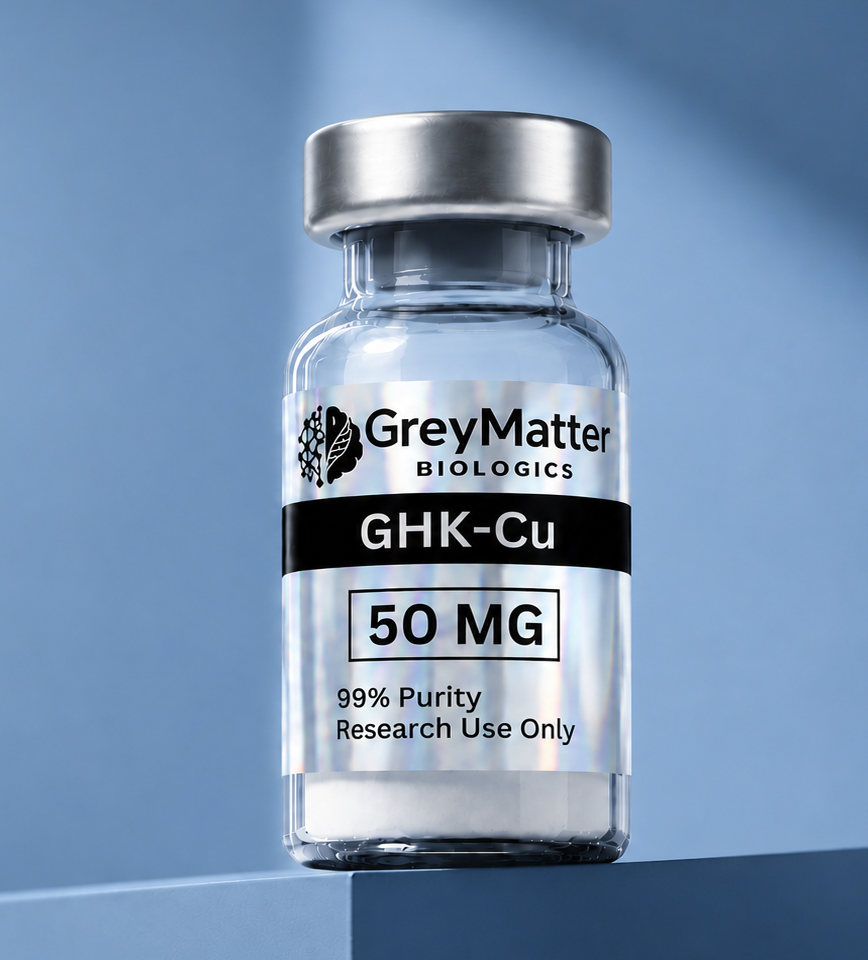
 Third-party tested
GHK-Cu
A naturally occurring copper tripeptide that promotes tissue remodeling, wound healing, and collagen synthesis in animal and in vitro studies.
Availability: 8 in stock
GHK-Cu, by the numbers.
Structural and laboratory facts that define this compound. For laboratory research use only.
Gly-His-Lys tripeptide
g/mol · copper complex
Peptide : Cu(II) complex
Identified in human plasma
The GHK-Cu molecule
A schematic atomic representation shown next to the compound's molecular data. The figure is illustrative, not a measured conformation.
How it is studied.
A naturally occurring copper-binding tripeptide with broad regenerative properties
GHK-Cu chelates copper(II) ions and delivers them to cells, activating copper-dependent enzymes essential for collagen crosslinking, antioxidant defense, and tissue remodeling.
- High-affinity copper(II) binding
- Activates lysyl oxidase for collagen crosslinking
- Supports superoxide dismutase activity
Stimulates fibroblasts to produce type I and III collagen, glycosaminoglycans, and decorin — rebuilding the extracellular matrix architecture in damaged tissue.
- 70% increase in collagen synthesis vs controls
- Glycosaminoglycan production enhanced
- Decorin synthesis for matrix organization
Gene expression studies show GHK-Cu modulates 4,000+ human genes, resetting expression patterns toward a healthier, more youthful state. This is among the broadest gene-modulatory effects of any known peptide.
- 4,000+ genes modulated toward health
- Upregulates DNA repair genes
- Suppresses inflammatory gene expression
Research pathway map
The primary pathways GHK-Cu is investigated against in laboratory models.
Compound details.
Storage & handling
Supplied as a lyophilized powder. Store the sealed vial refrigerated at 2–8°C, protected from light and moisture; −20°C for long-term storage. Keep reconstituted material refrigerated.
FEBS Lett · 1988Stimulation of collagen synthesis in fibroblast cultures by the tripeptide-copper complex glycyl-L-histidyl-L-lysine-Cu2+
Collagen synthesis in fibroblast cultures.
Maquart FX et al., 1988 · PubMed ↗Int J Mol Sci · 2018Regenerative and protective actions of the GHK-Cu peptide in the light of the new gene data
Review of GHK-Cu gene-expression data.
Pickart L, Margolina A, 2018 · PubMed ↗Biomed Res Int · 2015GHK peptide as a natural modulator of multiple cellular pathways in skin regeneration
Review of GHK cellular pathway research.
Pickart L et al., 2015 · PubMed ↗