

 Third-party tested
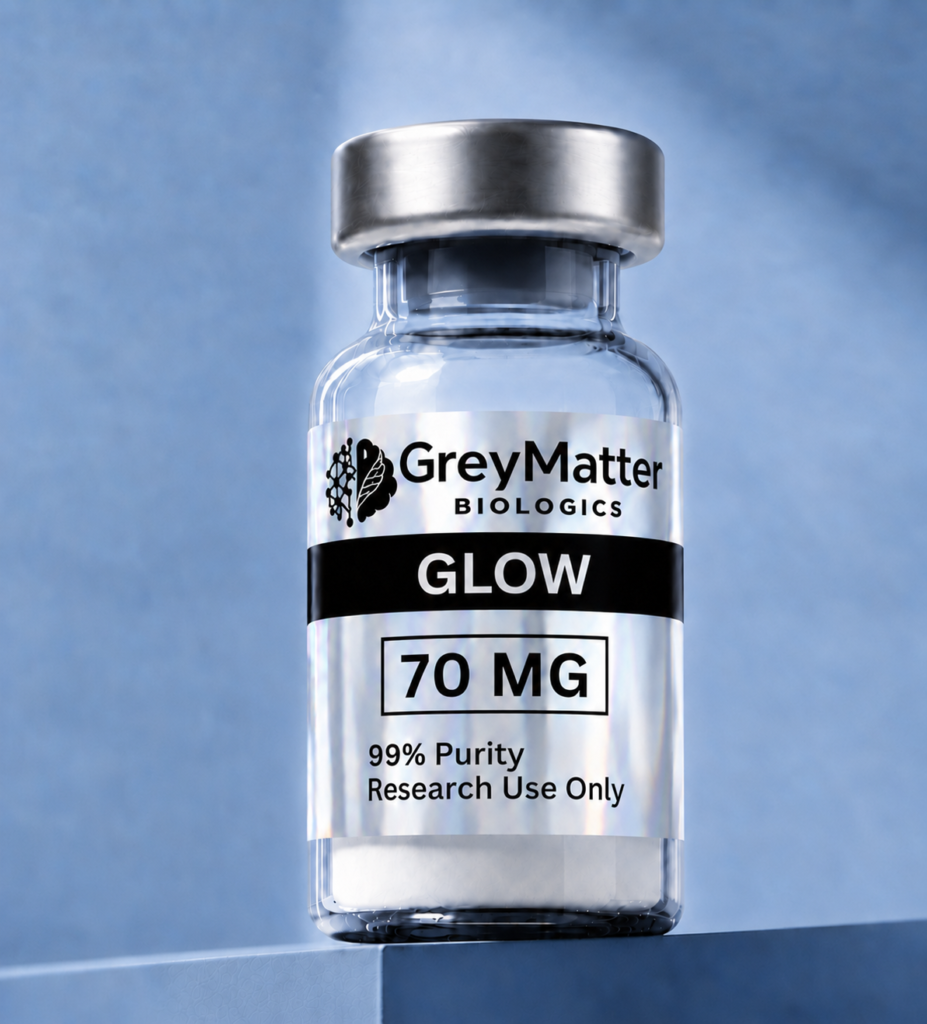
GLOW
A research blend of BPC-157, TB-500 and GHK-Cu, studied across angiogenic, actin-regulation and matrix pathways.
Out of stock
GLOW, by the numbers.
Structural and laboratory facts that define this compound. For laboratory research use only.
BPC-157 + TB-500 + GHK-Cu
Synthetic pentadecapeptide
Synthetic Thymosin β4
Copper tripeptide
How it is studied.
Three peptides targeting complementary regeneration pathways
Promotes blood vessel formation, enhances tissue granulation, and modulates nitric oxide signaling for vascular support to damaged tissue.
- Promotes blood vessel formation
- Enhances tissue granulation
- Modulates nitric oxide signaling
Increases cell migration, supports cytoskeletal remodeling, and reduces fibrotic scarring through thymosin beta-4 pathway activation.
- Increases cell migration
- Supports cytoskeletal remodeling
- Reduces fibrotic scarring
Stimulates type I & III collagen synthesis, modulates 4,000+ genes, and delivers copper to repair sites for extracellular matrix rebuilding.
- Stimulates type I & III collagen
- Modulates 4,000+ genes
- Delivers copper to repair sites
Research pathway map
The primary pathways GLOW is investigated against in laboratory models.
Compound details.
Storage & handling
Supplied as a lyophilized powder. Store the sealed vial refrigerated at 2–8°C, protected from light and moisture; −20°C for long-term storage. Keep reconstituted material refrigerated.
J Mol Med · 2017Therapeutic potential of pro-angiogenic BPC157 is associated with VEGFR2 activation and up-regulation
BPC-157 component.
Hsieh MJ et al., 2017 · PubMed ↗Expert Opin Biol Ther · 2012Thymosin β4: a multi-functional regenerative peptide. Basic properties and clinical applications
TB-500 component.
Goldstein AL et al., 2012 · PubMed ↗Int J Mol Sci · 2018Regenerative and protective actions of the GHK-Cu peptide in the light of the new gene data
GHK-Cu component.
Pickart L, Margolina A, 2018 · PubMed ↗