

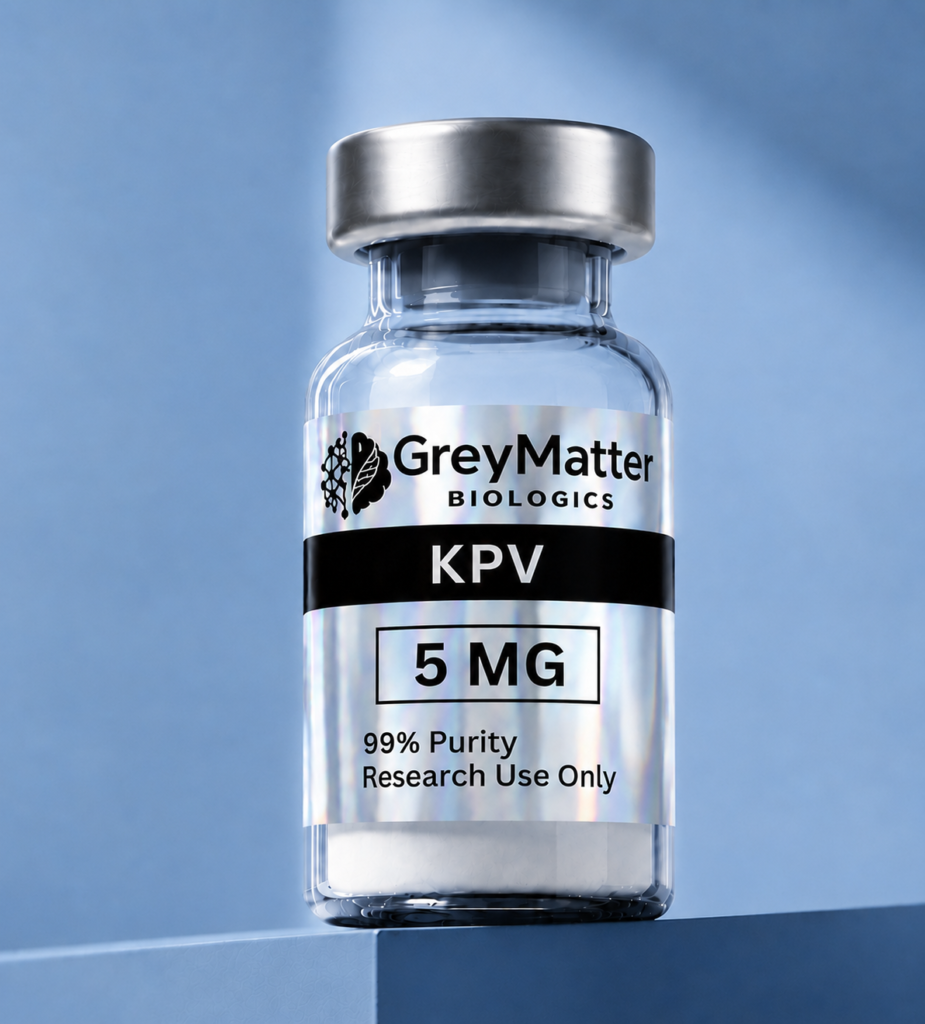
 Third-party tested
KPV
A tripeptide (Lys-Pro-Val) from the C-terminus of α-MSH, studied for inflammatory signaling in cell and animal models.
Availability: 10 in stock
KPV, by the numbers.
Structural and laboratory facts that define this compound. For laboratory research use only.
Lys-Pro-Val tripeptide
g/mol · C16H30N4O4
C-terminal tripeptide of α-MSH
Reverse-phase HPLC
The KPV molecule
A schematic atomic representation shown next to the compound's molecular data. The figure is illustrative, not a measured conformation.
How it is studied.
An α-MSH-derived tripeptide studied across inflammatory signaling, intestinal inflammation, and wound-healing research models
At nanomolar concentrations, KPV inhibits activation of the NF-κB and MAP-kinase inflammatory signaling pathways. By blunting NF-κB — a master regulator of inflammatory gene expression — KPV reduces secretion of pro-inflammatory cytokines such as TNF-α, IL-6 and IL-1β.
- Inhibits NF-κB and MAP-kinase signaling at nanomolar levels
- Reduces TNF-α, IL-6, IL-1β and other pro-inflammatory cytokines
- Suppresses inflammatory output rather than boosting anti-inflammatory cytokines
Research shows KPV is taken up by cells via the PepT1 di/tripeptide transporter, which is expressed on immune cells and intestinal epithelial cells. This transporter-mediated uptake allows KPV to act intracellularly on inflammatory signaling.
- Enters cells through the PepT1 peptide transporter
- PepT1 is expressed on immune and intestinal epithelial cells
- Enables intracellular modulation of inflammatory pathways
KPV is the C-terminal tripeptide of alpha-melanocyte-stimulating hormone (α-MSH 11–13). Research indicates most of α-MSH's anti-inflammatory activity can be attributed to this fragment, which also shows antimicrobial activity in published studies.
- C-terminal tripeptide of the melanocortin peptide α-MSH
- Carries much of α-MSH's anti-inflammatory activity
- Antimicrobial effects reported against S. aureus and C. albicans
Research pathway map
The primary pathways KPV is investigated against in laboratory models.
Compound details.
Storage & handling
Supplied as a lyophilized powder. Store the sealed vial refrigerated at 2–8°C, protected from light and moisture; −20°C for long-term storage. Keep reconstituted material refrigerated.
Gastroenterology · 2008PepT1-mediated tripeptide KPV uptake reduces intestinal inflammation
PepT1 uptake and inflammation models.
Dalmasso G et al., 2008 · PubMed ↗Inflamm Bowel Dis · 2008Melanocortin-derived tripeptide KPV has anti-inflammatory potential in murine models of inflammatory bowel disease
Murine colitis models.
Kannengiesser K et al., 2008 · PubMed ↗Trends Pharmacol Sci · 2002Melanocortin peptides and their receptors: new targets for anti-inflammatory therapy
Review of anti-inflammatory melanocortin research.
Getting SJ, 2002 · PubMed ↗