

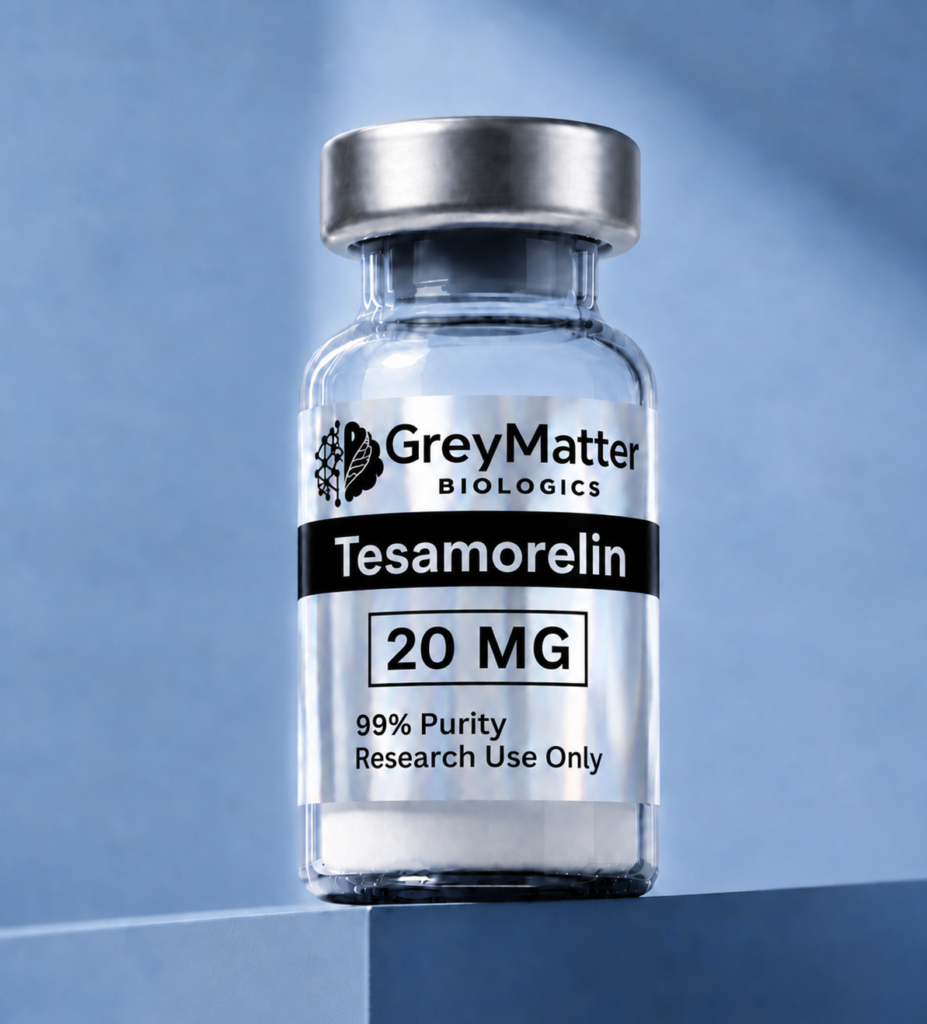
 Third-party tested
Tesamorelin
A 44-amino acid GHRH analog that stimulates pituitary gh secretion, studied for visceral adipose tissue reduction in clinical research.
Availability: 6 in stock
Tesamorelin, by the numbers.
Structural and laboratory facts that define this compound. For laboratory research use only.
Full-length GHRH(1-44) sequence
g/mol · C221H366N72O67S
trans-3-hexenoyl group for stability
Reverse-phase HPLC
The Tesamorelin molecule
A schematic atomic representation shown next to the compound's molecular data. The figure is illustrative, not a measured conformation.
How it is studied.
GHRH receptor signaling studied across metabolic, body composition, and cognitive research models
Tesamorelin is a synthetic trans-3-hexenoic acid-modified analog of human GHRH(1-44). It binds and activates pituitary GHRH receptors, stimulating endogenous growth hormone (GH) secretion while preserving normal pulsatile GH release patterns — unlike exogenous GH administration.
- Selective GHRH receptor agonism
- Preserves pulsatile GH secretion physiology
- Stimulates downstream IGF-1 production
Clinical evidence demonstrates tesamorelin reduces visceral adipose tissue (VAT) through GH-mediated lipolytic pathways. GH activates hormone-sensitive lipase in adipocytes, promoting free fatty acid release from visceral fat depots. This mechanism underlies its FDA-approved indication for HIV-related lipodystrophy.
- Stimulates GH-dependent hormone-sensitive lipase activity
- Selectively targets visceral (not subcutaneous) fat
- Preserves lean body mass in research models
Emerging research explores tesamorelin's effects on brain structure and function via IGF-1 signaling. Studies in older adults with mild cognitive impairment report changes in regional gray matter volume and functional connectivity. GH/IGF-1 axis modulation is hypothesized to support neuroplasticity mechanisms.
- Increases circulating IGF-1, which crosses the blood-brain barrier
- Associated with changes in cortical gray matter volume
- Under investigation for cognitive aging research models
Research pathway map
The primary pathways Tesamorelin is investigated against in laboratory models.
Compound details.
Storage & handling
Supplied as a lyophilized powder. Store the sealed vial refrigerated at 2–8°C, protected from light and moisture; −20°C for long-term storage. Keep reconstituted material refrigerated.
Basic Clin Pharmacol Toxicol · 2007Non-clinical pharmacology and safety evaluation of TH9507, a human growth hormone-releasing factor analogue
Preclinical pharmacology of TH9507.
Ferdinandi ES et al., 2007 · PubMed ↗N Engl J Med · 2007Metabolic effects of a growth hormone-releasing factor in patients with HIV
Clinical study of TH9507.
Falutz J et al., 2007 · PubMed ↗Lancet HIV · 2019Effects of tesamorelin on non-alcoholic fatty liver disease in HIV: a randomised, double-blind, multicentre trial
Clinical study of hepatic fat endpoints.
Stanley TL et al., 2019 · PubMed ↗